
Leave to Where
A cat, a volcano, and five years of bad seasons

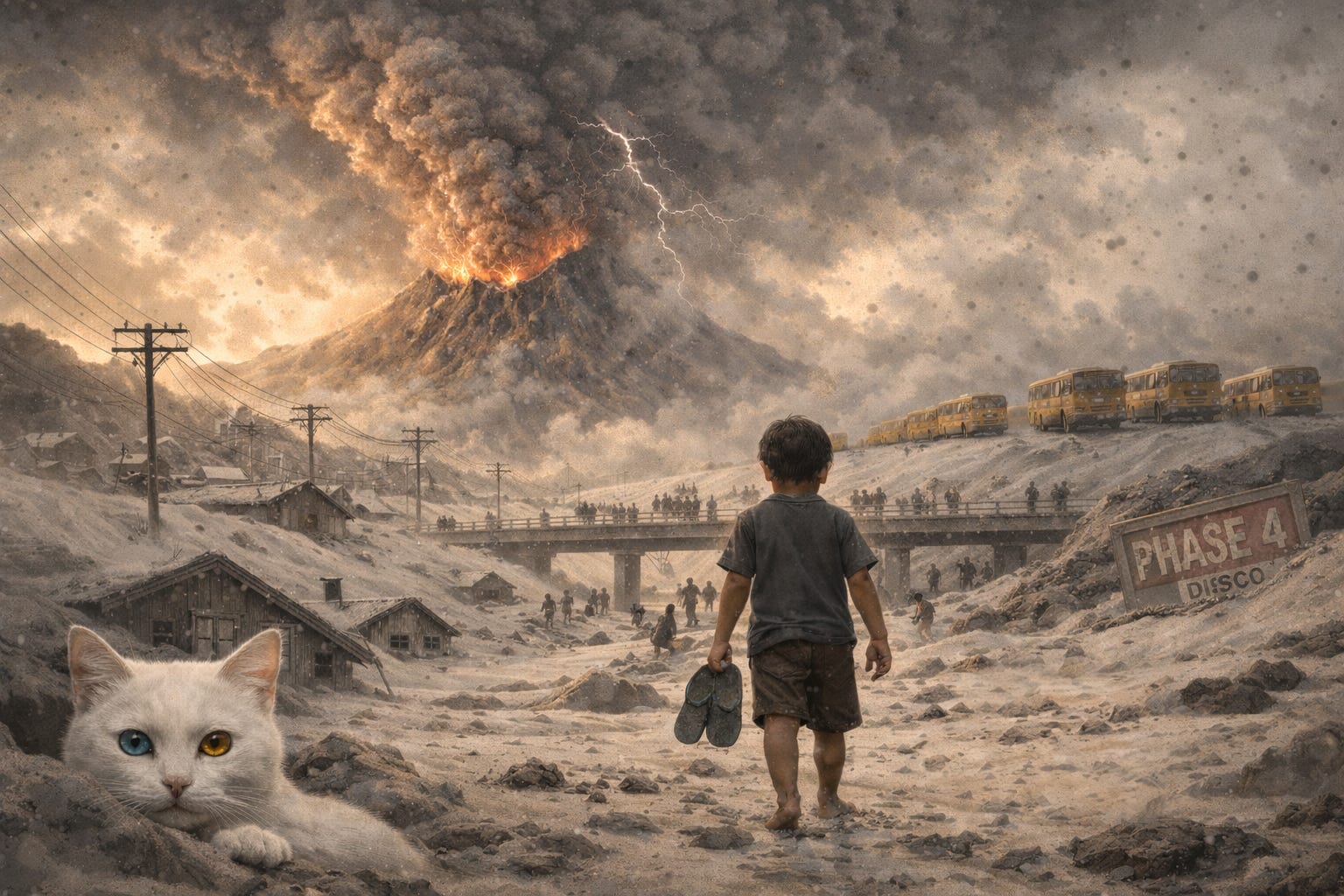
I named the cat Cleopatra because she had two different eyes, one blue, one amber, and carried herself like she owned a small kingdom, which in fairness she did, since no one had told her otherwise.
Years later, I would discover Cleopatra was male, and by then it felt rude to correct him.
* * *
Before the eruption, the mountain rehearsed the way old men do in the morning: restrained hacking, small tremors from the belly, steam, a few garbled sounds that nobody took seriously at first. Then government scientists started paying attention, and so did the Americans at Clark Air Base, about twenty-five kilometers from the volcano, a base the US had kept since the war, because the Philippines is very good at inheriting other people’s problems.
Pinatubo had been dormant for centuries, which is always how these stories go. By June 1991, it shifted to active, just like how it is described in textbooks: columns of ash rose kilometers into the sky, sulfur dioxide thickened the air until it smelled like the earth boiled eggs and forgot about them. They would later say it was one of the largest eruptions of the twentieth century, ash reaching the stratosphere, temperatures around the world dipping slightly, as if the planet had cleared its throat and swallowed something it could not quite put back. At the time, it just felt like the sky was getting warmed up.
The Aeta came down first, which should have told us something. They had lived on Pinatubo’s slopes for generations, way before ships plied the Manila-Acapulco route, and they read the mountain differently than the scientists did, through omens and the behavior of animals in the days before, so that by the time the instruments started registering what the Aeta already knew, they had already begun to move. They said the gods were angry, and they threw chickens and other offerings into the mouth of the volcano, and they were gone before we had finished deciding whether to believe them.
No one from the government came to tell the rest of us the same.
At Clark, the Americans had instruments: seismographs, gas measurements, warnings that came with charts and planes that could do fly-bys to verify if the mountain was indeed about to spew. With solid information and the organizational confidence of people who had somewhere to go, they put families on buses, one suitcase each, one pet, with controlled precision as if they had been rehearsing for the past century they had been in the country.
There were hundreds of them: Air Force servicemen, their wives, their children, dogs pressing their noses against the bus windows, and someone who had probably carried a cat.
We watched them pass, and we cheerily waved, and they waved hesitantly back and looked at us with confusion and a tinge of worry. They headed to Subic Bay Naval Base, a few hours away, down the mountains and to the sea, and then onto ships and planes, then to somewhere else entirely, Guam, Hawaii, places with names that did not include us.
They would not come back, as it turned out, and this is worth noting: Filipino nationalists had been trying to remove the Americans from Clark and Subic for decades, through protests and senate votes and the long, exhausting argument about what it means to have a foreign military base in the middle of your country. Pinatubo accomplished the whole thing in a weekend.
Later, I heard the Americans had told the government what was coming, but there was no plan for everyone else and so we stayed.
* * *
The sky thickened and blurred the sun until the middle of the day looked like early evening, and ash fell the way bad news does, first a little, then all at once, and somehow you are still surprised. As if the gods felt they had not made their point clearly enough, they sent Typhoon Yunya, whose name we did not know yet because we were busy, and the ash meeting the rain became something heavier and wetter than either, not ash, not rain, but a slow cement that made the roof creak ominously.
So we went up onto the roof in the pitch darkness, heavy mushroom clouds obliterating whatever light was coming from the sun, I could not see my hand in front of me and it was 2:00 in the afternoon, and started pushing the sand, or whatever it was, to the ground. My father handed my brothers the shovel and pointed at the far end of the roof. “You two, that side,” he said, with the calm of someone who had decided that panic was not useful and could wait. Since we only had one shovel, the rest of us improvised with pots and basins and, in my case, a plastic melamine plate that had survived years of birthday parties and spaghetti stains and was not designed for structural rescue. Neither were any of us.
The ash was warm and clinging and accumulated faster than we could argue with it, while the volcano accompanied everything with earthquakes, frequent, small but insistent, like a child pulling at your sleeve, and the electricity went out somewhere in between all of this.
We slept in the dark with everything awake: your ears first, then your skin, then something older than both of those, insisting leave. Leave to where? Cleo did not leave my arms.
* * *
In the morning, it was beautiful in the way that disasters sometimes are, everything softened into one color: ash-gray and serene, like a resort in the apocalypse. Our house was buried up to the windows, and the ground was still warm and emitting wisps of smoke, like it had just been freshly stir-fried.
My brother arrived barefoot from his house nearby, holding his flip-flops, looked around at the endless pale newly invented landscape, and asked, “Where is the beach?”
It was a fair question because it did look like one, and my four-year-old nephew ran ahead delighted until he tripped almost immediately, his body not yet calibrated for this version of the earth, and he screamed, not from the fall but from the burn, because the sand was not sand and was still carrying the mountain inside it.
“It’s hot! It’s hot!” he kept saying, which was accurate and, in retrospect, the most precise description anyone gave of the whole event.
The scar stayed for years, a thin lightning mark across his forehead ending with a circle at the tip of his nose, like an exclamation point etched on his face, the mountain’s signature on the smallest person in the family.
The eruption did not end so much as learn patience, and every rainy season the lahar came; ash and debris remobilized by rain, turning rivers into something muscular and unstoppable that you could hear before you saw it, like a thousand horses, like the earth had somewhere to be and was not going to apologize in its rush to get there.
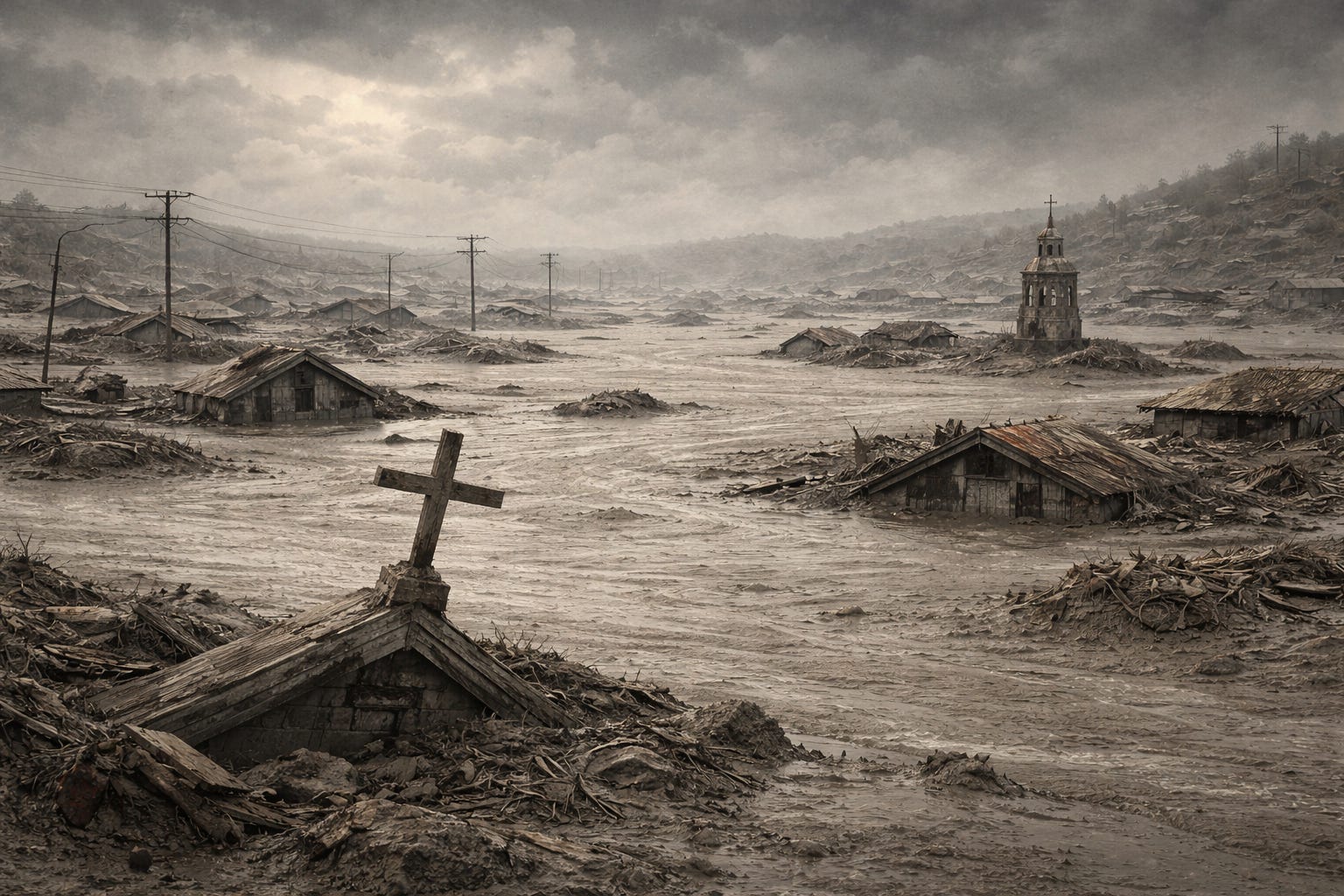
It swallowed roads and then memories of roads, took houses and churches whole—walls, roofs, the nails holding everything together—and in some towns was so complete that only the church crosses remained above the surface, sticking out of the ground like the whole town had been interred and someone had thought to leave a marker.
Friends who had survived the eruption lost everything to this second disaster, the slow one, the one that kept coming back for years. Some of them were pulled from their rooftops by helicopters, dangling above a neighborhood that no longer had the decency to look like one. One friend told me later that from the air, she couldn’t find her street, not because it had been destroyed but because it no longer existed as a category.
We lived like that for five years, which sounds like a long time until you meet the people still living in resettlement zones today, in houses that were meant to be transitional, waiting for a return that was never organized because the volcano was an event but the displacement became a permanent address.
There was no clean water for long stretches, electricity that came and went, neighbors sharing meals and the particular kind of tiredness that comes from being in crisis so long it stops feeling like a crisis and starts feeling like just your life. “Anong meron?” someone would ask, what’s happening, and the answer was always the same: everything, nothing new, the usual.
Dry season, the ash that had settled over everything would dry out and come inside regardless, layers of it on every surface, in every room, reappearing on anything you had just wiped down, kids suffering from respiratory problems from the dust. Then the rainy season brought the lahar, so the calendar had two entries: dust and flood, and there was no good time of year, only a different variety of bad.
The government sent nothing that mattered, while politicians debated dikes, whether to build them, remove them, or rebuild them. And the funds quietly went somewhere drier, so what arrived instead of help was each other, the improvised infrastructure of people who had no other option, which is a very Filipino solution to being abandoned.
When the lahar paused for a season, I would meet my friends, and since there were no roads we made our own, walking under a broken bridge and stepping from rock to rock with the careful timing of people who had spent their childhoods playing Turtle Bridge on the Game & Watch, jumping between rocks that looked like turtle shells that might or might not hold, which turned out to be useful training for exactly this kind of life.
On the other side of the broken bridge there was a disco called Phase 4, and the music did not care about lahar. Menudo’s Explosion, the Puerto Rican band, played like the world had not ended, or had decided not to, or had ended but was willing to make an exception for dancing. “Bakit nandito ka pa?” someone shouted at me over the music, why are you still here, and I didn’t know if they meant the disco or the province or the general situation, so I just danced, because at some point survival becomes habit, and habit looks a lot like living.
What I remember most clearly is not the eruption itself, nor the morning after, but just lying in the dark, while it was still happening, holding a cat named after a queen and listening to a roof decide if we were worth keeping.
He had survived a volcano, and he could keep the name.
Daisy this is so powerful! The pivotal point for me was “at some point survival becomes habit, and habit looks a lot like living”
Amazing 🤩